
Can you actually cheat or bot Poker Now?
If you searched "Poker Now hack," you're after one of four things: a see-opponent-cards extension, a browser exploit, an RNG break, or a magic bot. None of them survive contact with how pokernow.club actually deals a card. We'll walk you through each one, why it falls over, and the one attack that does work — which turns out to be a people problem, not a software one.
Who actually types "Poker Now hack"?
Before the technical part, it's worth being honest about who's searching. The intent splits into four groups: friends in a casual room who want to peek at each other's cards for the bit, viewers wondering if a Twitch streamer's home game is "rigged", people who confused Poker Now with PokerStars and arrived with the wrong vocabulary, and a small tail genuinely curious about web-app security. None of those overlaps with the buyers of serious real-money poker AI — which matters when you're sorting out what's even plausible.
| What people want | What it would need | Reality |
|---|---|---|
| See opponent cards | The server to send you cards you shouldn't have | None — cards never reach your browser before showdown |
| RNG break | Recover the shuffle state from observed deals | None — modern shuffles aren't invertible from what poker reveals |
| Memory / heap edit | The real game state to live on your machine | None — state lives on the server; edits are cosmetic |
| Browser-extension bot | Reliable page read + action clicks | Buildable, but useless on a free platform |
| Server-side exploit | A genuine vulnerability + a willingness to commit a crime | Possible in principle; the value is a bug bounty, not a $99 sale |
| Collusion via outside chat | Friends and a side channel | Works — and it's the only "hack" with real effect |
Five of the six are either architecturally closed, economically pointless, or both. The sixth isn't a hack — it's a social problem solved by trust. The rest of this piece is the justification.
Why "see opponent cards" is dead on arrival
This is the biggest single bucket of search volume, and it has the cleanest answer. On any modern web poker client, Poker Now included, opponent hole cards never leave the server. The deal is computed server-side. Your client receives only what it's entitled to: your own hole cards, the community board as it appears, the public action log, and chip movement for each seat. Opponent cards are revealed only at showdown, and only the ones that get there.
That's not special to Poker Now — it's how every serious web card game works in 2026, because the alternative (sending all cards to all clients and trusting nobody looks) has been a known anti-pattern since the early online-poker era. The app doesn't need to be anti-cheat-heavy to get this right; it just needs to not be obviously broken at the protocol level, and after years of public availability there's no working "see cards" tool — which is the empirical proof.
The extensions that claim otherwise are uniformly one of three things: a placebo that does nothing visible, a phishing wrapper presenting a fake Google or pokernow.club login to pocket your credentials, or a bundle hiding a coin-miner or info-stealer in the installer. None produce card data, because there's no card data on your machine to extract.
Why RNG prediction doesn't work, even on a free app
The common assumption is "a free app probably cheaped out on shuffling." It's wrong. Card shuffling in web poker uses a cryptographically secure random generator, seeded from multiple entropy sources at start and reseeded on a schedule. The deal is committed on the server before any card reaches a client, and individual reveals are an opaque slice of that committed deal.
The "just observe enough output and reverse the seed" idea hits a bandwidth wall before it hits the cryptographic one. A secure generator produces output at enormous rates; a poker hand exposes a tiny, filtered sliver — roughly fifty bits of card information a few times a minute, most of it hidden from any one observer.
Generator output rate:        ~10^9 bits/sec (theoretical)
Info exposed per Poker Now room:  ~50 bits/hand x ~200 hands/hour
                              = ~10,000 bits/hour = ~2.8 bits/sec
Attack ratio:                 ~3.6 x 10^8 : 1
You can't reconstruct a 256-bit internal state from a signal attenuated by eight orders of magnitude. The famous historical breaks (the iPoker 2013 incident) were specific bugs in a shuffle algorithm, not a generic weakness — and even if such a bug surfaced on Poker Now, there's no withdrawable balance, so there's no payoff for the person who finds it.
Cheat Engine and the server-authoritative state
A chunk of searches land on YouTube clips of someone running Cheat Engine on a browser and "winning" a play-money hand. Misleading at best. Your browser's memory holds your view of the game — your cards, the stacks the server told you about, the visual table. Editing those values changes what your screen shows, not what the server decided. If you edit "I have aces" into local memory, the server still thinks you have seven-deuce, and the showdown resolves on what the server thinks.
It's like trying to win an online chess game by dragging your local board into checkmate. The server is the authority; the client is a display. Memory editing only matters in games where the real state lives on the client — single-player, or badly designed multiplayer that trusts the client. Poker Now is neither.
DIY bots: buildable, but pointless
Browser-extension bots that play Poker Now hands are technically buildable. Read the page, identify your cards and the betting state, run a baseline strategy, and emit clicks through the accessibility tree. A decent engineer could prototype it over a weekend, and a few stale GitHub projects have. What does not exist is a production-grade commercial bot — for reasons that have nothing to do with difficulty.
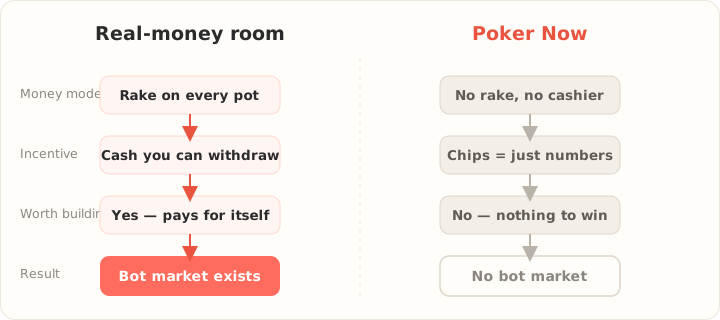
Serious poker AI is anchored to solver outputs — counterfactual-regret strategies from PioSolver or MonkerSolver, compressed into fast inference tables, paired with an opponent model that updates within tens to low hundreds of hands. Building that costs engineering-years. Maintaining it costs more, because rooms ship interface updates that break the action layer several times a year. The only thing that pays for it is a stable stream of cash at withdrawal. Poker Now has no withdrawal — the chips a bot "wins" vanish when the room closes. Every free poker app has the same problem, which is why none of them have a serious bot market either.
The scam-listing economy
So why do the Telegram and marketplace listings persist? Because the listing itself is profitable whether or not the product works. Three drivers: the cost of spinning up an LLM-generated storefront has collapsed to near zero, crypto and gift-card checkouts make taking money frictionless, and the buyer demographic — casual players hoping to cheat friends, teenagers from YouTube thumbnails — rarely issues chargebacks.
The math works even at a one-percent conversion rate. At a $50 ticket and essentially zero acquisition cost, a single page pays for itself with twenty sales out of two thousand visits, and the seller has no ongoing obligation because there's no product to support. It's a content-marketing scam more than a software one, and it'll persist as long as the search volume does. The right move as a reader: assume any "Poker Now bot for sale" listing is one of these. The prior is high enough that no single claim moves it.
Curious about the real-money side?
The actual poker-AI engineering lives at real-money rooms, not here. If that's what you're after — or you're a host who wants a clean room — the Telegram chat reaches the Poker Bot AI team.
The one attack that works: collusion
What does work is collusion — and it's the vector the app genuinely can't solve. Two friends in a Discord voice call discussing their hole cards during a third friend's game. A text thread sharing screenshots between hands. A couple on separate devices in the same kitchen. The app sees only the in-game actions, and the actions of a colluding pair aren't statistically distinguishable from two friends who happen to play similar styles, especially over a single night's small sample.
Picture the simplest version: player A picks up aces preflop and says "I'm in" on the call; player B folds whatever they have and gives A a clean lane. Over forty hands the swing from that one trick alone is substantial. Over a month of weekly games it compounds into a real chunk of the group's settled cash.
# Information-shared collusion at one table
# Two colluders (A, B); three honest players (C, D, E).
# Voice channel carries hole-card info every hand.
#
#   if my hand strong AND B weak:   play normally, extract from C/D/E
#   if my hand weak   AND B strong: fold early, give B a clean lane
#   if both strong:                 avoid each other, pick on others
#
# Net effect: visibility on 2/5 seats ~ +25-35% EV vs honest pool
# Platform-visible signature: none, looks like style overlap
The interesting part is that this is also the cheat with the highest social cost. The room is private — the host chose every player by name. If two people collude, the third figures it out eventually: results that defy the math over a few weeks, suspicious timing on big pots, a friend who quietly stops wanting to host them. The penalty isn't a platform ban; it's not getting invited back, the friend group hearing about it, and the trust evaporating. For most Poker Now rooms, that's enough. The app's anti-cheat is, in effect, the host's group chat — and on a free social app, that's the right design.
What Poker Now's actual anti-cheat looks like
The app does have countermeasures — deliberate and intentionally limited. The room creator can password-protect the room, kick players, ban by IP or account, lock seats to invited players, set rebuy limits, and control the blind structure. None of that is anti-cheat in the security-stack sense; they're room-management tools that happen to be enough for a private game. Beyond that there's manual moderation: a small ops team responds to abuse reports on a queue measured in days, and a clear pattern of complaints from independent rooms can eventually trigger an account-level ban.
There's no behavioural fingerprinting layer in the GGPoker sense, no nightly play-pattern scan, no anti-collusion graph joining accounts by deposit method (there are no deposits). Building that would cost engineering-years to run, and there's no revenue funding it.
The real-money contrast
For contrast, the model serious operators run looks roughly like four layers: behavioural fingerprinting on action timing and input patterns; statistical play-pattern analysis flagging distributional outliers; anti-collusion graph models joining accounts by IP, device, deposit method and table co-occurrence; and human review, the decisive layer where a reviewer reads hand history and signs off most bans. Those combine into a per-account risk score with a calibrated false-positive budget.
Operators do this because the cost is small relative to the rake stream it protects. Poker Now doesn't, because there's no rake stream. The platforms that look most like it are other free social card apps; the ones that look least like it are licensed real-money rooms — which is exactly where a serious commercial bot market actually exists, and where the interesting engineering happens.
If you came here looking for a Poker Now bot, the honest answer is that the interesting work isn't happening on this platform — and that's a feature of Poker Now's design, not a bug. If you're a host who wants to keep a clean room, the playbook is short: vet the seats, watch result variance over a long sample, be wary of voice-chat pairs with unusual results, use the abuse-report flow for outsiders, and settle openly so the math stays visible. None of it is exotic — it's what home-game hosts have done for decades.
Hosting a game and want a sanity check?
If you're running a Poker Now home game and worried about collusion, or just want a second opinion on your room setup, the chat reaches the team. We've looked at a lot of rooms.